Note from Sri Prahlada
January has been a wonderful month for kirtan in Sydney. On the 22nd and 23rd, we had a 40 hour kirtan celebrating the 40th Anniversary of the Hare Krishna community in Sydney and Australia. One of the highlights was a performance by Swamis from Satyananda Yoga at Mangrove Mountain. Another highlight was the kirtans performed by Gaura Vani and his USA based group As Kindred Spirits. They are currently on tour in Australia and I had the fortune of attending each of the group’s six concerts in Sydney. I have a particular affection for these kirtan musicians as lead singer Gaura Vani and bass player Shree Shyam and I all went to school together in 1980s at an ashram in Vrindavan India.
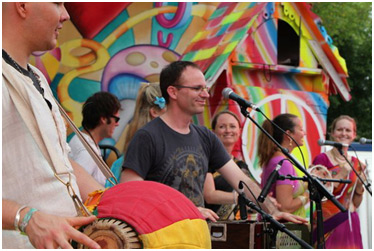
In January we also had the opportunity to share kirtan on the Lily World stage for each of the two days of the ‘Big Day Out’ in Sydney. It was a different environment to that of a peaceful Yoga School, so we kept the tempo more upbeat. Despite the 40+ degree heat, hundreds of people danced in front of the stage. After the second day, I asked two girls who had been dancing ecstatically in front of the stage how they liked the kirtan. They replied they had never experienced anything so wonderful and blissful as kirtan. They said that although it was over 40 degrees, they had goose bumps all over the bodies from the chanting!
So, just what happens to people in kirtan? This is the focus of this issue of Kirtan Magic, covered in our feature article entitled “What are the Benefits of Kirtan?”. Please enjoy and feel free to get involved by commenting below, and of course I hope to meet you soon at one of our upcoming kirtan events!
With affection,
Om & Prem
Sri Prahlada
[headline h=”1″]What are the Benefits of Kirtan?[/headline]
Recently, I was asked to explain the benefits of kirtan to the owner of a yoga school who was considering organizing a kirtan concert. My response was that in kirtan people experience:
• Inner peace
• Happiness
• Opening of the heart with feelings of love and compassion
• Connection with the Divine and other kirtan participants
• On occasion, goose bumps and tears as the heart jumps with joy
I then offered that there were three authorities from which to understand the benefits of kirtan:
1. Personal experience
2. Academic research findings
3. The authority of Vedic-yoga texts.
[headline h=”1″]Personal experience[/headline]

Most kirtan authorities share that the benefits of kirtan cannot be explained in words, it has to be experienced in order to be understood. How do you explain the taste of a mango to someone who has never tasted these fruits? You can intellectualise over the taste by saying its something like a cross between a peach, pineapple, and an orange, but until a person tastes a mango, they can never really know it’s flavour. The same is with the experience of kirtan – you have to experience it to know what it is. Sacinandana Swami put it eloquently when he wrote: “Words can show us the direction in which to look for the kirtan-experience, but only when you sit down, move towards your inner space, and then sing out, will you start to know what kirtan really is. Because at that time your soul will rise up and start to dance…”
Another thing is that different people will experience kirtan differently. Some people might immediately love it, like meeting a long lost friend or returning home after a long time away. Others might take a little while to get used to an unfamiliar experience. Additionally, kirtan can often sound raw and unpolished. Hence, some might find the mango a little green – immature and therefore unpalatable. But in India, people love green mangos (eaten with salt and chilli powder pickled) as much as they love ripe mangos. They can also discern between different varieties of mangos – some are sweeter and others have a slightly bitter taste, others stringy, and others are more or less firm. Similarly, a kirtan connoisseur can discern and appreciate different varieties and flavours of kirtan.
My personal experience of kirtan is that when the lead chanter and the group participants are sincere and sing from the heart with devotion – there is nothing in the world that has the power to move and uplift me like kirtan. When I look back on my life, my happiest, most blissful moments, were all in kirtan.
[headline h=”1″]Academic research findings[/headline]
In the past several years, with the increasing awareness and appreciation of kirtan in the Western yoga community, it has also come to attract the attention of academic researchers. In the USA, Black and Vaugn made kirtan the focus of their Masters theses (respectively in music and psychology), while Cooke made it the focus of her PhD in music. Each of these qualitative studies involved interviews with kirtan participants. Interestingly, three similar themes emerged relating to the benefits of kirtan. In each study it was found that kirtan:
1. Induces a powerful sense of connection with the Divine.
2. Induces trance like meditative states of altered consciousness, including feeling of spiritual upliftment that last long after the kirtan event has concluded.
3. Opens the heart, allowing greater connection and community amongst other kirtan participants, even those of diverse backgrounds and traditions.
[headline h=”1″]The teachings of the Vedic-yoga texts[/headline]
Interestingly, study of the Vedic-yoga texts reveals similar themes, but describes the benefits of kirtan at a deeper level. This is a level that is not consciously perceptible to the senses. My analysis of the Vedic-yoga texts unveils five themes:
1. The first benefit is that kirtan chanting destroys negativity. The Yoga Sutras (1.27-31) state that chanting om destroys “disease, procrastination, laziness, doubt, pain, nervousness, and lamentation”. According to the Vedic-yoga tradition, such negative conditions as disease, and mental distress are the result of deeper negative psychological impressions from unwholesome actions performed even in previous lifetimes – bad karma. Therefore, the more important benefit of kirtan is that it destroys the seeds of negativity waiting to sprout as the result of negative karma from previous lifetimes. In this regard, the Brhad-vishnu Purana goes as far as saying that chanting one holy name destroys more negative karma than a person is able to commit. It is natural that when a person is free from the burden of negativity they will be peaceful and happy. This leads us to…
2. The second benefit is that it awakens blissfulness or natural joy within the heart. Arjuna declares in the Bhakgavad-gita (11.36), “the world becomes joyful upon hearing your name”.
3. The third benefit of kirtan is that it is easy to perform. The Skanda Purana states that chanting the name of Hari (a name of the Divine which means one who takes away all distress) just once, guarantees liberation. Because it is easy, it is also described as the most practical method for attaining spiritual perfection, particularly in this age, hence…
4. The fourth benefit is that it is described as the topmost spiritual process. The Srimad Bhagavatam describes kirtan as the “ultimate spiritual practice” (6.3.22) and as the “doubtless and fearless way of success” (2.1.11) in any endeavour – spiritual or material. Similarly, Bhagavad-gita (10.25) describes it as the topmost form of sacrifice.
5. Finally, the fifth benefit of kirtan is that it creates Divine connection, which is the greatest of all benefits. This connection transpires both as the experience of Divine presence and as the awakening loving affection. Regarding the experience of Divine presence, Krishna tells Narada in the Padma Purana; “My dear Narada, actually I do not reside in my abode, Vaikuntha, nor do I reside in the heart of the yogis, but I reside in that place where devotees sing my holy names”.
The loving affection that awakens in the heart during kirtan is mutual both for the chanter and the Divine. The chanter comes to love the Divine, as Arjuna tells Krishna in in the Bhagavad-gita (10.25) that when people hear Your name “everyone becomes attached to you”. Likewise, the Divine comes to loves the chanter ever more. In this regard Krishna declares in the Adi Purana, “When a person chants My name, whether out of devotion or indifference, then the chanters name will remain forever in My heart. I will never forget such a soul”.
So you can see, the benefits of kirtan described in the Vedic-yoga texts is similar to those people explain from their personal experience, but it goes further by describing benefits at a level that is beyond the purview of our limited sensory perception.
For example, while people describe that kirtan relieves distress and induces a state of peace. The Vedic-yoga texts reveal, however, that the effects of kirtan destroy negative karma even from previous lives that is yet un-manifest.
Similarly, while people describe a felt sense of spiritual connection. The yoga texts reveal that this connection is mutual and reciprocated by the Divine, who “will never forget” the name of the person who chants the holy name.
[headline h=”1″]The teachings of Chaitanya[/headline]
Chaitanya is the personality who 500 years ago, revolutionised spirituality in India by promoting kirtan as the easiest and most practical path to enlightenment. He wrote eight stanzas of spiritual instruction called the Shikshastakam. The first of these stanzas summarises the teachings of the Vedic-yoga texts by describing seven benefits to chanting similar those described above. These are that kirtan:
1. Cleanses the heart of all sinful impressions and desires
2. Destroys all suffering by ending the cycle of birth and death
3. Awakens all auspiciousness and good fortune
4. Reveals knowledge of ones true spiritual nature and relationship with the Divine
5. Awakens the highest bliss
6. Delivers the nectar of immortality
7. Allows one to share the highest Divine love by purifying one of all selfish desires for personal pleasure.
[headline h=”1″]Conclusion[/headline]
In conclusion, analysis of people’s personal experience as well as the Vedic-yoga teachings reveals that kirtan offers wonderful material, emotional, and spiritual benefits – for body, mind, and spirit. Sometimes kirtan is compared to India’s legendary kalpa-vrksa “wish-tree”, which can grant wishes. So why limit our comparison of kirtan to a mango which must be experienced to know its flavour? A wish-tree can deliver pineapples, coconuts, and anything else you might desire.
What benefits have you gained from kirtan? What are your most memorable kirtan moments? Please visit our blog to share your experiences!
[headline h=”1″]Want To Use This Article?[/headline]
You’re welcome to share this article as long as you include this complete blurb with it:
For more kirtan articles, music samples & downloads, event news, and short films and other kirtan resources visit http://www.sriprahlada.com and become a member of Sri Prahlada’s Kirtan Community for FREE. Aside from instant access to a lot of fantastic kirtan resources, you will also receive Sri Prahlada’s e-newsletters with news, realizations, and experiences with kirtan.
8 replies on “What are the Benefits of Kirtan?”
What are my most memorable kirtan moments? There are many, but there is one that stands out in particular, and I think it highlights the power of kirtan as a yoga practice. I had this experience after chanting for two or so hours straight at a festival. This was at that point the longest kirtan I had taken part in, and the result was profound. I remember it distinctly because I had been studying yoga for sometime, and I was sincerely seeking to experience what I had read about so often in various yoga texts. Call it samadhi, egolessness, freedom from thought, or as Mr Iyengar phrases it “the sight of the soul.” Up until this kirtan festival I had had different meditation experiences whilst practicing yoga, and although they were eye opening in and of themselves, I was still not convinced if I had “found the truth.” Then I found myself leaving the kirtan hall in a state of tranquility and sublime happiness. This I had experienced in kirtan before, but not to this degree, and this time it was accompanied by the overwhelming conviction that “THIS IS IT!” It was tangible and real, and I had no doubt in my mind that I was perhaps having myself on, convincing myself that I was meditating like I had done at yoga retreats in the past. It occurred to me this is what the yoga texts described.
As I was relishing this new found bliss, I had an experience that I will never forget; I forgot my own name. Truthfully. I couldn’t remember my own name. It was a little bit disconcerting to be honest. After all our name is what we answer when we are asked “Who are you?” It is our identity. Without it we are forced to ask the question “Who am I?” And that is what I did. Desperately. But after a few moments it came back to me and all was well. The bliss was still there, and a delicious lunch was about to be served, so I put it out of my mind. 😉 But I was left with the impression of a deep spiritual experience and a new appreciation of kirtan as a powerful yoga practice.
My most memorable kirtan moment was a hall full of kirtanlovers and everyone eyes shut absorbed in the Holy Names. I was right at the back trying to balance myself on my toes and during a short stretch of music amidst kirtan I opened my eyes just to see myself raised to the front near the beautiful deities of Sri Sri Radha Gopinath. I love the energy and positive vibes flowing across the room when everyone is literally surrendered to the Holy Names, thats when you realise Krishna is actually present in the form of His Names. Its all “spiritual” and I have full confidence that Kirtan will take me Back to Lord Hari! Thank you for such enlightening Kirtan experiences Sri Prahlad Das.
It’s kind of kirten is whoever will see will love to attend the kirten party……Sri Prahlad Prabhuji Ki Jay!!
HareKrishna,
Great, how i missed this website up to now ?!
Thanks
your servant
Gaur Gadadhar das
SpiritualQuest
Jaya Sri Prahlada! Thank you for the nice article. My question is does the above also apply to recitation of the Lord’s Names in japa meditation (quietly to oneself)? Can, or does, the reference to “kirtan” include japa? I find similar experiences in japa to congregational chanting.
Hi Paul, In most ways the same benefits apply to chanting the holy names as japa. The main difference is that in kirtan we experience more heart connection with other chanters and other living beings in general. Japa is more of a personal experience where the relationship is experienced mainly between the chanter and the Supreme Divine.
This atrcile keeps it real, no doubt.
A million thanks for posting this information.