Categories
Latest News

Chant Constantly

Caitanya, the inaugurator of the sankirtan movement in India some 500 years ago, advised that people should “sing kirtan constantly” kirtaniya sada harih. How is it possible to constantly chant the holy names? Caitanya says it is only possible if we cultivate attitudes of humility, tolerance, and respect towards others. Caitanya’s message is taken to heart in Vrindavan, a sacred town with thousands of Krishna temples in Northern India. On my first day here on a recent visit, I smiled seeing how people communicate with each other by chanting names of the divine. A meeting between friends or strangers is rarely expressed as a “Hi” or “How are you” but rather as “Radhe Radhe” (names of the feminine divine Radha), or Hare Krishna (Radha Krishna), or Hari Bol (chant the holy name). With these names shopkeepers also sell their wares, beggars collect alms, and drivers seek passage for their vehicles. Wondering through this ancient town, you see people quietly muttering the Hare Krishna maha-mantra, counting their number of recitations on tulsi wood beads, which they carry in a cloth bag on their right hand. You also hear kirtan floating down narrow alleys out of gateways to homes and temples. In some temples kirtan is held 24 hours per day, 365 days of the year, for the past 40 years.

One such temple is the Krishna Balaram Mandir where I stayed for a couple of weeks. I lived and went to an ashram school here for a year when I was 9-10 years old. People come from around the world to participate in kirtan shifts. For example on my visit I met Vishnu, a friend from Melbourne Australia, who is also an expert mrdanga drummer, and has been here for several months. He has two shifts each day – from 10 AM to 1 PM and from 10 PM to 1 AM – a total of 8 hours each day! He relishes the quiet and dark hours of the early morning the most, when it is just him, a couple of friends, their instruments, and the mantra. They chant, and chant, in the mood of the residents of Vrindavan, with humility, tolerance, and respect.

It is always a joyful experience for me to return here to meet familiar people and places, and hear the stories of Krishna’s pastimes here in Vrindavan. My greatest joy here comes from joining in the 24-hour kirtan. I don’t have the humility, tolerance, and respect, to stay here and chant constantly – this remains an aspiration.

Categories
Latest News

Chanting with Gratitude

The Greek philosopher Epictetus (AD 55 – AD 135) said, “He is a wise man who does not grieve for the things which he has not, but rejoices for those which he has”. And Gilbert Chesterton (1874-1936), an English writer and poet, similarly stated, “I would maintain that thanks are the highest form of thought, and that gratitude is happiness doubled by wonder”.

I often begin kirtan sessions by pausing to feel grateful. I invoke feelings of gratitude by reflecting upon my spiritual guides and mentors who have inspired me on my spiritual journey, and nurtured me in my spiritual practice. I feel myself blessed and thankful for their much love. This helps me to become present, to derive the full benefits of kirtan; it sets my intention. Thus, it enhances my kirtan experience in a powerful way. It is also my way of maintaining the ancient kirtan tradition of beginning a kirtan session with prayers to spiritual teachers and mentors – taking blessings, and invoking divine presence in a sacred space.

I also try to lead my audience (fellow kirtan participants) in experiencing gratitude when I lead public kirtan sessions. I ask participants to reflect and consider: “Who are the special people (mentors, friends, teachers, parents, God) who have been instrumental in inspiring you on your spiritual path? How have these people helped bring you to this moment?” This reflection on kindness and inspiration instantly awakens within the audience the “great-attitude” of a “maha-atma”.

In leading my audience through this simple gratitude practice, I am consciously guiding them through a two-stage process of acknowledgement and recognition. Acknowledgement involves willing acceptance of the goodness in the gifts bestowed by other’s efforts. Recognition involves understanding that other people, nature, or God, are the source of received goodness. Thus, I lead my audience engaging both their heads and their hearts. Their heads are engaged in thoughtful acknowledgement of a specific benefit and thoughtfully recognising their outer sources of those benefits. Their hearts are engaged in expressing feelings of appreciation towards bestower of those benefits. This coming together of head and heart completes the expression of gratitude.

The outcomes of an attitude of gratitude according to positive psychology research include happiness, wellbeing, optimism, vitality, hope, kindness, empathy, and spirituality. Add that to the most profound blissful and heart awakening experience of kirtan – and nothing can be better!

Categories
Latest News

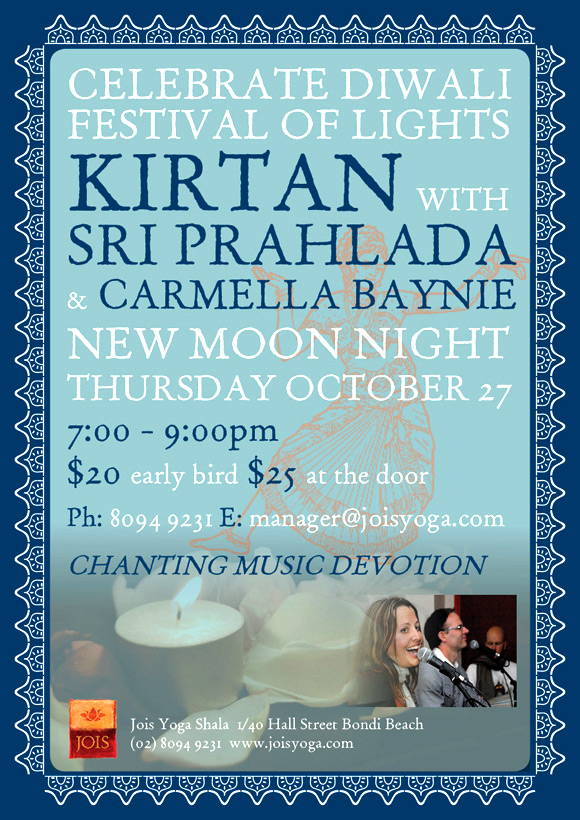
Diwali Festival of Lights with Sri Prahlada and Carmella Baynie

Time: 27 October · 19:00 – 21:00
Location: 1/40 Hall Street Bondi Beach NSW 2026; Jois Yoga Bondi
Celebrate Diwali Festival of Lights with Sri Prahlada

$20 early bird, $25 at the door

Contact/ Bookings: (02)8094 9231
manager@joisyoga.com
www.joisyoga.com

Categories
Latest News

The Mayapuris are coming to Sydney! (VIDEO)

Categories
Latest News

Chant Fest-Spring Immersion

Kirtan with THE MAYAPURIS & SRI PRAHLADA

Time
15 October · 19:00 – 22:30

Location
Manly Youth Centre

Kangaroo St
Manly NSW


More info
The Mayapuris only Sydney concert!

THE MAYAPURIS & SRI PRAHLADA

When: Saturday 15TH October 2011
Time: 7.00pm – 10.30pm
Where: Manly Youth Centre, Kangaroo St Manly
Fee: Early Bird $40 paid by 8th October
Full Fee: $50
Bookings: 9977 4725
Online Bookings available www.manlyyoga.com.au

7.00 pm Sri Prahlada
8.00pm Savouries, Sweets & Chai Stalls Open
8.30pm The Mayapuris

info@manlyyoga.com.au
www.manlyyoga.com.au

*** Please bring your own cushion.

Categories
Latest News

The Power of Kirtan – More Than Mere Stress Relief

There are numerous meditation techniques. Amongst these, mantra meditation is particularly prominent amongst practitioners of devotional yoga or bhakti-yoga. The Sanskrit word ‘man’ means mind, while ‘tra’ means to free. Mantra meditation frees your mind of fear and anxiety. But, it does even more than this, it opens your heart to reveal your spiritual nature of eternity and bliss.

Increased complexity in today’s fast paced world makes learning to free your mind particularly important. In previous generations life was simpler and possibly less convenient, but it was also less stressful. Threatening situations activate your body’s parasympathetic nervous system, releasing stress hormones to equip your body to address the threat. Your heartbeat quickens, your muscles tighten, you have increased energy, and your immunity and digestion shut down.

The threats your ancestors encountered in prehistoric times were immediate dangers, such as wild animals, that were quickly addressed. Once the danger was over, the parasympathetic nervous system was activated so their muscles could again relax, with their heart rate slowing, and their digestion again activated. This allowed their bodies to quickly return to a resting state for recovery.

Unfortunately, today’s pressures are constant. Workplace demands, tense relationships, deadlines, traffic jams, and fear of terrorism are unceasing threats. All of these stressors cause people to become anxious and lose tempers in anger. As such, many people are always in a fight or flight state and never come to relax and recover. They cannot sleep, digest, they have aches and pains in their bodies, and their immunity is depleted. The body cannot maintain this state of heightened alert for an extended duration of time. Over time, it leads to a crisis involving physical and emotional breakdown along with depression.

The interesting thing about this stress response is that it is activated whether the threat is real or imagined. Whether you feel threatened by a snake, or a rope that you mistake for a snake, your body will respond the same way. The body responds to the mind. Negative thoughts and emotions create a negative a defense response, while positive thoughts and emotions create a relaxation and recovery response.

Modern science has found many practical outcomes of meditation as a way of nurturing a relaxed state for self-rejuvenation and healing. Yes, your body has an amazing ability to heal itself, if only given a chance. Medically meditation has been demonstrated to reduce symptoms of cardio and gastrointestinal disease, as well as reduce mood disorders of stress, depression, anger, irritability, and anger. It has also been found to thicken the parts of the brain’s cerebral cortex responsible for decision-making, attention, and memory. The greater benefit of mantra meditation, however, that was the focus of the ancients is that it awakens your spiritual nature and connects you in yoga with Divine Consciousness.

There are two types of mantra meditation: japa and kirtana. Japa is a form of meditation involving the meditative repetition of a mantra or name of the Divine. This practice of repetitive prayer is present in varied forms within most spiritual traditions in the world, although the yoga tradition of India generally gives more emphasis to it as a specific discipline. Beads called japa-mala are used to count the repetitions of mantra chanting. One mantra is chanted on each bead before moving onto the next. The number of beads in the japa mala is generally 108. The main purpose of the beads is to keep track of the number of mantras chanted. One cycle of the 108 beads is called “one round”. Bhakti yoga practitioners decide on a minimum number of rounds they want to chant each day. Fingering the beads also help one focus on the sound of the mantra. Of all mantras the most powerful and highly recommended by Chaitanya and other greater teachers is the Hare Krishna maha-mantra or great chant to free the mind.

Kirtan is another type of mantra meditation. The process of kirtan involves singing sacred mantras to the accompaniment of musical instruments. Generally, it involves a call-and-response style of singing where the leader sings a mantra and the audience chants in response. Thus, kirtan includes the audience in the performance. Kirtan is a culture where people can share spiritual meditation in a joint spiritual experience. Often it begins with all the participants sitting meditatively, but ends with joyous dancing as kirtan awakens the natural joy of the soul. Kirtan is increasingly gaining popularity in yoga schools all over the world that organise regular kirtan events with invited kirtan musicians. But you don’t have to attend an outside event, or even be a musician to sing kirtan, you can also do kirtan at home with friends and family. And if you don’t have friends with whom to share kirtan, you might engage in kirtan by responding to a singer’s chanting on a CD.

Categories
Latest News

Kirtan by Sri Prahlada at Jois Yoga

On Friday, July 15th, Jois Yoga will be celebrating the life and teachings of Pattabhi Jois, the found of asthanga yoga, with kirtan lead by Sri Prahlada. This will be Sri Prahlada’s first kirtan in Sydney on his return from a European kirtan tour. The program will begin from 4:30-5:30 with a Puja ceremony with Ramachandra (all welcome) and be followed by kirtan and dinner from 6:30-9 PM ($20 prebookings essential).

POSTER (PDF 154 Kb) >>

FACEBOOK PAGE FOR THIS EVENT >>

Categories
Latest News

Why Maha Mantra Kirtan?

The Kali Santarana Upanisad

I like to sing many different ancient sacred mantras in kirtan, but my favourite is the maha-mantra. People sometimes ask me about the origin of the maha-mantra – I reply that spiritual tradition holds the mantra to be eternal but revealed in time in different sacred texts. The chief amongst such texts is the Kali Santarana Upanisad, which describes how chanting this mantra is the best thing one can do for the benefit of humanity in this age. Hence, I have decided to present the full text of the ancient Sanskrit work, The Kali Santarana Upanisad. This Upanisad, consisting of 11 verses, is counted as number 103 in the cannon of 108 Upanisads. This translation is by Swami Gaurangapada. – Sri P

The maha-mantraThe maha-mantra

Hari Om! After travelling all over the world, Shrila Narada Muni approached Lord Brahma (his own father and guru) during the time when Dvapara-yuga was about to end. He asked him, “O Lord! How will all the living entities be able to deliver themselves from the most degraded age of Kali which is about to begin”. [1]

(Note: According to Vedic teachings dvapara-yuga is the last age, while kali-yuga is the current age – Sri P)

Lord Brahma replied, “You have asked the most important and relevant question for the benefit of humanity. I will tell you now the most concealed secret of the Vedic literatures, with the help of which everyone can easily cross this most dangerous age of Kali. [2]

“Simply by chanting the transcendental names of the original enjoyer and the Supreme Personality of Godhead, Lord Narayana, all the sins will be cleansed in Kali-yuga.” [3]

Narada Muni again asked, “Which are those specific names of the Lord which are most effective in Kali-yuga?” [4]

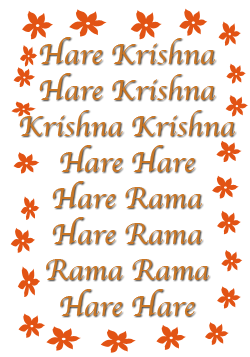
Lord Brahma replied, “The sixteen words – Hare Krishna, Hare Krishna, Krishna Krishna, Hare Hare; Hare Rama, Hare Rama, Rama Rama, Hare Hare – are especially meant for completely destroying all the contamination of Kali. To save oneself from the contamination of Kali-yuga, there is no alternative in all the Vedas except the chanting of this sixteen-word mantra. [5-6]

(Note: Some versions of Kali Santarana Upanishad have Hare Rama appearing first, followed by Hare Krishna. This is possibly a change by followers of Rama who placed Rama’s name before Lord Krishna’s. We draw this conclusion because other scriptures such as Agni Purana, Sanat-kumara Samhita and Vayu Purana, which refer to the maha-mantra, all have the maha-mantra begining with Hare Krishna. – Sri P)

“This maha-mantra consisting of sixteen names of Krishna is the destroyer of the (16-layered) illusory covering of all the living entities. Only when the coverings are destroyed, Lord Krishna, the Supreme Personality of Godhead will appear in the heart of the living entities, just like the sun appears with full intensity when the clouds are removed.” [7]

Shrila Narada again inquired from Lord Brahma – “What are the procedures and rules for chanting this maha-mantra?” [8]

Lord Brahma replied, “There are no rules and regulations to chant this maha-mantra. It should be chanted always irrespective of whether one is in a pure or impure condition.” [9]

When one chants the 16 names of the maha-mantra 35 million times (sardha trikotir), he absolves himself of the sins of killing a brahmana or a kshatriya, stealing of gold or engaging in harmful activities towards one’s forefathers or other living entities. [10]

By chanting the maha-mantra, one becomes quickly purified from all sins accumulated due to rejecting all of one’s duties in our past lives. Thus the Hare Krishna maha-mantra, is the only means, the only means, the only means of thoroughly and immediately purifying oneself in Kali-yuga. Thus ends the Kali-santarana Upanishad. [11]

Categories
Latest News

Sri Prahlada kirtan at Qi Yoga March 5th

Categories
Latest News

What are the Benefits of Kirtan?

Note from Sri Prahlada

January has been a wonderful month for kirtan in Sydney. On the 22nd and 23rd, we had a 40 hour kirtan celebrating the 40th Anniversary of the Hare Krishna community in Sydney and Australia. One of the highlights was a performance by Swamis from Satyananda Yoga at Mangrove Mountain. Another highlight was the kirtans performed by Gaura Vani and his USA based group As Kindred Spirits. They are currently on tour in Australia and I had the fortune of attending each of the group’s six concerts in Sydney. I have a particular affection for these kirtan musicians as lead singer Gaura Vani and bass player Shree Shyam and I all went to school together in 1980s at an ashram in Vrindavan India.
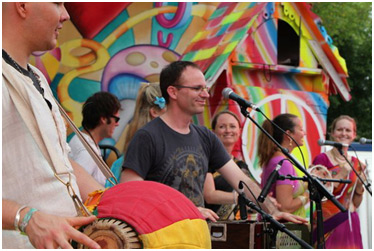
In January we also had the opportunity to share kirtan on the Lily World stage for each of the two days of the ‘Big Day Out’ in Sydney. It was a different environment to that of a peaceful Yoga School, so we kept the tempo more upbeat. Despite the 40+ degree heat, hundreds of people danced in front of the stage. After the second day, I asked two girls who had been dancing ecstatically in front of the stage how they liked the kirtan. They replied they had never experienced anything so wonderful and blissful as kirtan. They said that although it was over 40 degrees, they had goose bumps all over the bodies from the chanting!

So, just what happens to people in kirtan? This is the focus of this issue of Kirtan Magic, covered in our feature article entitled “What are the Benefits of Kirtan?”. Please enjoy and feel free to get involved by commenting below, and of course I hope to meet you soon at one of our upcoming kirtan events!

With affection,
Om & Prem
Sri Prahlada


[headline h=”1″]What are the Benefits of Kirtan?[/headline]
Recently, I was asked to explain the benefits of kirtan to the owner of a yoga school who was considering organizing a kirtan concert. My response was that in kirtan people experience:

• Inner peace
• Happiness
• Opening of the heart with feelings of love and compassion
• Connection with the Divine and other kirtan participants
• On occasion, goose bumps and tears as the heart jumps with joy

I then offered that there were three authorities from which to understand the benefits of kirtan:

1. Personal experience
2. Academic research findings
3. The authority of Vedic-yoga texts.

[headline h=”1″]Personal experience[/headline]
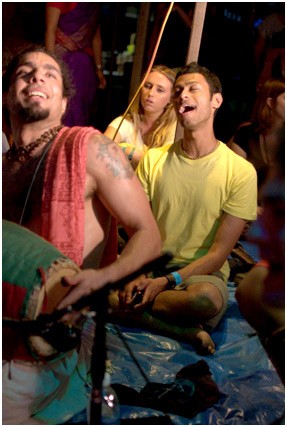
Most kirtan authorities share that the benefits of kirtan cannot be explained in words, it has to be experienced in order to be understood. How do you explain the taste of a mango to someone who has never tasted these fruits? You can intellectualise over the taste by saying its something like a cross between a peach, pineapple, and an orange, but until a person tastes a mango, they can never really know it’s flavour. The same is with the experience of kirtan – you have to experience it to know what it is. Sacinandana Swami put it eloquently when he wrote: “Words can show us the direction in which to look for the kirtan-experience, but only when you sit down, move towards your inner space, and then sing out, will you start to know what kirtan really is. Because at that time your soul will rise up and start to dance…”

Another thing is that different people will experience kirtan differently. Some people might immediately love it, like meeting a long lost friend or returning home after a long time away. Others might take a little while to get used to an unfamiliar experience. Additionally, kirtan can often sound raw and unpolished. Hence, some might find the mango a little green – immature and therefore unpalatable. But in India, people love green mangos (eaten with salt and chilli powder pickled) as much as they love ripe mangos. They can also discern between different varieties of mangos – some are sweeter and others have a slightly bitter taste, others stringy, and others are more or less firm. Similarly, a kirtan connoisseur can discern and appreciate different varieties and flavours of kirtan.

My personal experience of kirtan is that when the lead chanter and the group participants are sincere and sing from the heart with devotion – there is nothing in the world that has the power to move and uplift me like kirtan. When I look back on my life, my happiest, most blissful moments, were all in kirtan.

[headline h=”1″]Academic research findings[/headline]

In the past several years, with the increasing awareness and appreciation of kirtan in the Western yoga community, it has also come to attract the attention of academic researchers. In the USA, Black and Vaugn made kirtan the focus of their Masters theses (respectively in music and psychology), while Cooke made it the focus of her PhD in music. Each of these qualitative studies involved interviews with kirtan participants. Interestingly, three similar themes emerged relating to the benefits of kirtan. In each study it was found that kirtan:

1. Induces a powerful sense of connection with the Divine.
2. Induces trance like meditative states of altered consciousness, including feeling of spiritual upliftment that last long after the kirtan event has concluded.
3. Opens the heart, allowing greater connection and community amongst other kirtan participants, even those of diverse backgrounds and traditions.

[headline h=”1″]The teachings of the Vedic-yoga texts[/headline]
Interestingly, study of the Vedic-yoga texts reveals similar themes, but describes the benefits of kirtan at a deeper level. This is a level that is not consciously perceptible to the senses. My analysis of the Vedic-yoga texts unveils five themes:

1. The first benefit is that kirtan chanting destroys negativity. The Yoga Sutras (1.27-31) state that chanting om destroys “disease, procrastination, laziness, doubt, pain, nervousness, and lamentation”. According to the Vedic-yoga tradition, such negative conditions as disease, and mental distress are the result of deeper negative psychological impressions from unwholesome actions performed even in previous lifetimes – bad karma. Therefore, the more important benefit of kirtan is that it destroys the seeds of negativity waiting to sprout as the result of negative karma from previous lifetimes. In this regard, the Brhad-vishnu Purana goes as far as saying that chanting one holy name destroys more negative karma than a person is able to commit. It is natural that when a person is free from the burden of negativity they will be peaceful and happy. This leads us to…

2. The second benefit is that it awakens blissfulness or natural joy within the heart. Arjuna declares in the Bhakgavad-gita (11.36), “the world becomes joyful upon hearing your name”.

3. The third benefit of kirtan is that it is easy to perform. The Skanda Purana states that chanting the name of Hari (a name of the Divine which means one who takes away all distress) just once, guarantees liberation. Because it is easy, it is also described as the most practical method for attaining spiritual perfection, particularly in this age, hence…

4. The fourth benefit is that it is described as the topmost spiritual process. The Srimad Bhagavatam describes kirtan as the “ultimate spiritual practice” (6.3.22) and as the “doubtless and fearless way of success” (2.1.11) in any endeavour – spiritual or material. Similarly, Bhagavad-gita (10.25) describes it as the topmost form of sacrifice.

5. Finally, the fifth benefit of kirtan is that it creates Divine connection, which is the greatest of all benefits. This connection transpires both as the experience of Divine presence and as the awakening loving affection. Regarding the experience of Divine presence, Krishna tells Narada in the Padma Purana; “My dear Narada, actually I do not reside in my abode, Vaikuntha, nor do I reside in the heart of the yogis, but I reside in that place where devotees sing my holy names”.

The loving affection that awakens in the heart during kirtan is mutual both for the chanter and the Divine. The chanter comes to love the Divine, as Arjuna tells Krishna in in the Bhagavad-gita (10.25) that when people hear Your name “everyone becomes attached to you”. Likewise, the Divine comes to loves the chanter ever more. In this regard Krishna declares in the Adi Purana, “When a person chants My name, whether out of devotion or indifference, then the chanters name will remain forever in My heart. I will never forget such a soul”.

So you can see, the benefits of kirtan described in the Vedic-yoga texts is similar to those people explain from their personal experience, but it goes further by describing benefits at a level that is beyond the purview of our limited sensory perception.

For example, while people describe that kirtan relieves distress and induces a state of peace. The Vedic-yoga texts reveal, however, that the effects of kirtan destroy negative karma even from previous lives that is yet un-manifest.

Similarly, while people describe a felt sense of spiritual connection. The yoga texts reveal that this connection is mutual and reciprocated by the Divine, who “will never forget” the name of the person who chants the holy name.

[headline h=”1″]The teachings of Chaitanya[/headline]
Chaitanya is the personality who 500 years ago, revolutionised spirituality in India by promoting kirtan as the easiest and most practical path to enlightenment. He wrote eight stanzas of spiritual instruction called the Shikshastakam. The first of these stanzas summarises the teachings of the Vedic-yoga texts by describing seven benefits to chanting similar those described above. These are that kirtan:

1. Cleanses the heart of all sinful impressions and desires
2. Destroys all suffering by ending the cycle of birth and death
3. Awakens all auspiciousness and good fortune
4. Reveals knowledge of ones true spiritual nature and relationship with the Divine
5. Awakens the highest bliss
6. Delivers the nectar of immortality
7. Allows one to share the highest Divine love by purifying one of all selfish desires for personal pleasure.

[headline h=”1″]Conclusion[/headline]
In conclusion, analysis of people’s personal experience as well as the Vedic-yoga teachings reveals that kirtan offers wonderful material, emotional, and spiritual benefits – for body, mind, and spirit. Sometimes kirtan is compared to India’s legendary kalpa-vrksa “wish-tree”, which can grant wishes. So why limit our comparison of kirtan to a mango which must be experienced to know its flavour? A wish-tree can deliver pineapples, coconuts, and anything else you might desire.

What benefits have you gained from kirtan? What are your most memorable kirtan moments? Please visit our blog to share your experiences!
[headline h=”1″]Want To Use This Article?[/headline]
You’re welcome to share this article as long as you include this complete blurb with it:
For more kirtan articles, music samples & downloads, event news, and short films and other kirtan resources visit http://www.sriprahlada.com and become a member of Sri Prahlada’s Kirtan Community for FREE. Aside from instant access to a lot of fantastic kirtan resources, you will also receive Sri Prahlada’s e-newsletters with news, realizations, and experiences with kirtan.