Let’s get ready for Sri Prahlada’s Kirtan at Qi Yoga. This is going to be his first Kirtan after a long break. 27th of May at Freshwater.
Bookings at www.qiyoga.net

Let’s get ready for Sri Prahlada’s Kirtan at Qi Yoga. This is going to be his first Kirtan after a long break. 27th of May at Freshwater.
Bookings at www.qiyoga.net
|
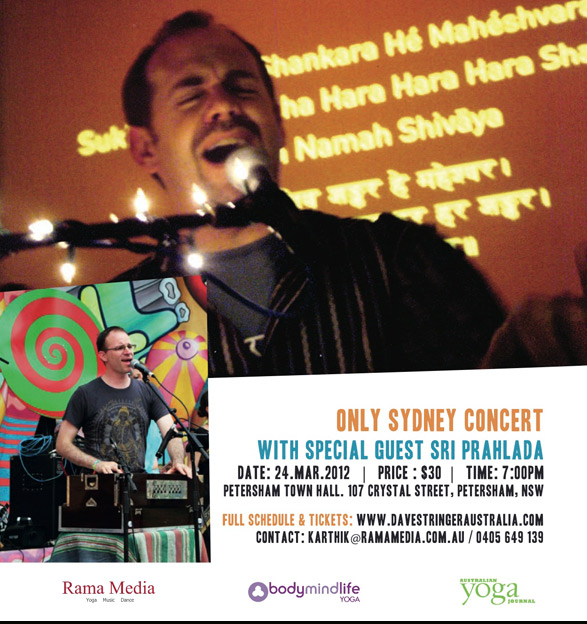
Earth Hour Kirtan Concert with Sri Prahlada, Carmella & Edo and Jo
|
|
THE EARTH HOUR CONCERT TURN OFF YOUR LIGHTS 31st of March 2012 Concert Starts at 7pm Edo & Jo Chai and snacks served at the event Free event; Places limited. Artists: Sri Prahlada: www.sriprahlada.com |
| Website |
|---|
Caitanya, the inaugurator of the sankirtan movement in India some 500 years ago, advised that people should “sing kirtan constantly” kirtaniya sada harih. How is it possible to constantly chant the holy names? Caitanya says it is only possible if we cultivate attitudes of humility, tolerance, and respect towards others. Caitanya’s message is taken to heart in Vrindavan, a sacred town with thousands of Krishna temples in Northern India. On my first day here on a recent visit, I smiled seeing how people communicate with each other by chanting names of the divine. A meeting between friends or strangers is rarely expressed as a “Hi” or “How are you” but rather as “Radhe Radhe” (names of the feminine divine Radha), or Hare Krishna (Radha Krishna), or Hari Bol (chant the holy name). With these names shopkeepers also sell their wares, beggars collect alms, and drivers seek passage for their vehicles. Wondering through this ancient town, you see people quietly muttering the Hare Krishna maha-mantra, counting their number of recitations on tulsi wood beads, which they carry in a cloth bag on their right hand. You also hear kirtan floating down narrow alleys out of gateways to homes and temples. In some temples kirtan is held 24 hours per day, 365 days of the year, for the past 40 years.
One such temple is the Krishna Balaram Mandir where I stayed for a couple of weeks. I lived and went to an ashram school here for a year when I was 9-10 years old. People come from around the world to participate in kirtan shifts. For example on my visit I met Vishnu, a friend from Melbourne Australia, who is also an expert mrdanga drummer, and has been here for several months. He has two shifts each day – from 10 AM to 1 PM and from 10 PM to 1 AM – a total of 8 hours each day! He relishes the quiet and dark hours of the early morning the most, when it is just him, a couple of friends, their instruments, and the mantra. They chant, and chant, in the mood of the residents of Vrindavan, with humility, tolerance, and respect.
It is always a joyful experience for me to return here to meet familiar people and places, and hear the stories of Krishna’s pastimes here in Vrindavan. My greatest joy here comes from joining in the 24-hour kirtan. I don’t have the humility, tolerance, and respect, to stay here and chant constantly – this remains an aspiration.
The Greek philosopher Epictetus (AD 55 – AD 135) said, “He is a wise man who does not grieve for the things which he has not, but rejoices for those which he has”. And Gilbert Chesterton (1874-1936), an English writer and poet, similarly stated, “I would maintain that thanks are the highest form of thought, and that gratitude is happiness doubled by wonder”.
I often begin kirtan sessions by pausing to feel grateful. I invoke feelings of gratitude by reflecting upon my spiritual guides and mentors who have inspired me on my spiritual journey, and nurtured me in my spiritual practice. I feel myself blessed and thankful for their much love. This helps me to become present, to derive the full benefits of kirtan; it sets my intention. Thus, it enhances my kirtan experience in a powerful way. It is also my way of maintaining the ancient kirtan tradition of beginning a kirtan session with prayers to spiritual teachers and mentors – taking blessings, and invoking divine presence in a sacred space.
I also try to lead my audience (fellow kirtan participants) in experiencing gratitude when I lead public kirtan sessions. I ask participants to reflect and consider: “Who are the special people (mentors, friends, teachers, parents, God) who have been instrumental in inspiring you on your spiritual path? How have these people helped bring you to this moment?” This reflection on kindness and inspiration instantly awakens within the audience the “great-attitude” of a “maha-atma”.
In leading my audience through this simple gratitude practice, I am consciously guiding them through a two-stage process of acknowledgement and recognition. Acknowledgement involves willing acceptance of the goodness in the gifts bestowed by other’s efforts. Recognition involves understanding that other people, nature, or God, are the source of received goodness. Thus, I lead my audience engaging both their heads and their hearts. Their heads are engaged in thoughtful acknowledgement of a specific benefit and thoughtfully recognising their outer sources of those benefits. Their hearts are engaged in expressing feelings of appreciation towards bestower of those benefits. This coming together of head and heart completes the expression of gratitude.
The outcomes of an attitude of gratitude according to positive psychology research include happiness, wellbeing, optimism, vitality, hope, kindness, empathy, and spirituality. Add that to the most profound blissful and heart awakening experience of kirtan – and nothing can be better!
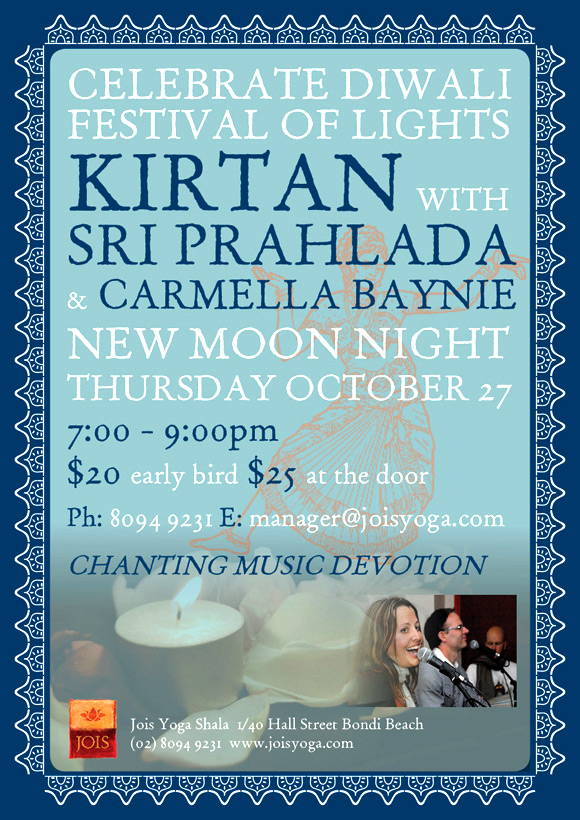
Time: 27 October · 19:00 – 21:00
Location: 1/40 Hall Street Bondi Beach NSW 2026; Jois Yoga Bondi
Celebrate Diwali Festival of Lights with Sri Prahlada
$20 early bird, $25 at the door
Contact/ Bookings: (02)8094 9231
manager@joisyoga.com
www.joisyoga.com

| Time |
15 October · 19:00 – 22:30
|
|---|---|
|
|
|
| Location |
Manly Youth Centre
Kangaroo St
Manly NSW
|
|
|
|
|
|
|
| More info |
The Mayapuris only Sydney concert!
THE MAYAPURIS & SRI PRAHLADA When: Saturday 15TH October 2011 7.00 pm Sri Prahlada info@manlyyoga.com.au *** Please bring your own cushion. |
There are numerous meditation techniques. Amongst these, mantra meditation is particularly prominent amongst practitioners of devotional yoga or bhakti-yoga. The Sanskrit word ‘man’ means mind, while ‘tra’ means to free. Mantra meditation frees your mind of fear and anxiety. But, it does even more than this, it opens your heart to reveal your spiritual nature of eternity and bliss.
Increased complexity in today’s fast paced world makes learning to free your mind particularly important. In previous generations life was simpler and possibly less convenient, but it was also less stressful. Threatening situations activate your body’s parasympathetic nervous system, releasing stress hormones to equip your body to address the threat. Your heartbeat quickens, your muscles tighten, you have increased energy, and your immunity and digestion shut down.
The threats your ancestors encountered in prehistoric times were immediate dangers, such as wild animals, that were quickly addressed. Once the danger was over, the parasympathetic nervous system was activated so their muscles could again relax, with their heart rate slowing, and their digestion again activated. This allowed their bodies to quickly return to a resting state for recovery.
Unfortunately, today’s pressures are constant. Workplace demands, tense relationships, deadlines, traffic jams, and fear of terrorism are unceasing threats. All of these stressors cause people to become anxious and lose tempers in anger. As such, many people are always in a fight or flight state and never come to relax and recover. They cannot sleep, digest, they have aches and pains in their bodies, and their immunity is depleted. The body cannot maintain this state of heightened alert for an extended duration of time. Over time, it leads to a crisis involving physical and emotional breakdown along with depression.
The interesting thing about this stress response is that it is activated whether the threat is real or imagined. Whether you feel threatened by a snake, or a rope that you mistake for a snake, your body will respond the same way. The body responds to the mind. Negative thoughts and emotions create a negative a defense response, while positive thoughts and emotions create a relaxation and recovery response.
Modern science has found many practical outcomes of meditation as a way of nurturing a relaxed state for self-rejuvenation and healing. Yes, your body has an amazing ability to heal itself, if only given a chance. Medically meditation has been demonstrated to reduce symptoms of cardio and gastrointestinal disease, as well as reduce mood disorders of stress, depression, anger, irritability, and anger. It has also been found to thicken the parts of the brain’s cerebral cortex responsible for decision-making, attention, and memory. The greater benefit of mantra meditation, however, that was the focus of the ancients is that it awakens your spiritual nature and connects you in yoga with Divine Consciousness.
There are two types of mantra meditation: japa and kirtana. Japa is a form of meditation involving the meditative repetition of a mantra or name of the Divine. This practice of repetitive prayer is present in varied forms within most spiritual traditions in the world, although the yoga tradition of India generally gives more emphasis to it as a specific discipline. Beads called japa-mala are used to count the repetitions of mantra chanting. One mantra is chanted on each bead before moving onto the next. The number of beads in the japa mala is generally 108. The main purpose of the beads is to keep track of the number of mantras chanted. One cycle of the 108 beads is called “one round”. Bhakti yoga practitioners decide on a minimum number of rounds they want to chant each day. Fingering the beads also help one focus on the sound of the mantra. Of all mantras the most powerful and highly recommended by Chaitanya and other greater teachers is the Hare Krishna maha-mantra or great chant to free the mind.
Kirtan is another type of mantra meditation. The process of kirtan involves singing sacred mantras to the accompaniment of musical instruments. Generally, it involves a call-and-response style of singing where the leader sings a mantra and the audience chants in response. Thus, kirtan includes the audience in the performance. Kirtan is a culture where people can share spiritual meditation in a joint spiritual experience. Often it begins with all the participants sitting meditatively, but ends with joyous dancing as kirtan awakens the natural joy of the soul. Kirtan is increasingly gaining popularity in yoga schools all over the world that organise regular kirtan events with invited kirtan musicians. But you don’t have to attend an outside event, or even be a musician to sing kirtan, you can also do kirtan at home with friends and family. And if you don’t have friends with whom to share kirtan, you might engage in kirtan by responding to a singer’s chanting on a CD.