Categories
Latest News

Kirtan by Sri Prahlada at Jois Yoga

On Friday, July 15th, Jois Yoga will be celebrating the life and teachings of Pattabhi Jois, the found of asthanga yoga, with kirtan lead by Sri Prahlada. This will be Sri Prahlada’s first kirtan in Sydney on his return from a European kirtan tour. The program will begin from 4:30-5:30 with a Puja ceremony with Ramachandra (all welcome) and be followed by kirtan and dinner from 6:30-9 PM ($20 prebookings essential).

POSTER (PDF 154 Kb) >>

FACEBOOK PAGE FOR THIS EVENT >>

Categories
Latest News

Why Maha Mantra Kirtan?

The Kali Santarana Upanisad

I like to sing many different ancient sacred mantras in kirtan, but my favourite is the maha-mantra. People sometimes ask me about the origin of the maha-mantra – I reply that spiritual tradition holds the mantra to be eternal but revealed in time in different sacred texts. The chief amongst such texts is the Kali Santarana Upanisad, which describes how chanting this mantra is the best thing one can do for the benefit of humanity in this age. Hence, I have decided to present the full text of the ancient Sanskrit work, The Kali Santarana Upanisad. This Upanisad, consisting of 11 verses, is counted as number 103 in the cannon of 108 Upanisads. This translation is by Swami Gaurangapada. – Sri P

The maha-mantraThe maha-mantra

Hari Om! After travelling all over the world, Shrila Narada Muni approached Lord Brahma (his own father and guru) during the time when Dvapara-yuga was about to end. He asked him, “O Lord! How will all the living entities be able to deliver themselves from the most degraded age of Kali which is about to begin”. [1]

(Note: According to Vedic teachings dvapara-yuga is the last age, while kali-yuga is the current age – Sri P)

Lord Brahma replied, “You have asked the most important and relevant question for the benefit of humanity. I will tell you now the most concealed secret of the Vedic literatures, with the help of which everyone can easily cross this most dangerous age of Kali. [2]

“Simply by chanting the transcendental names of the original enjoyer and the Supreme Personality of Godhead, Lord Narayana, all the sins will be cleansed in Kali-yuga.” [3]

Narada Muni again asked, “Which are those specific names of the Lord which are most effective in Kali-yuga?” [4]

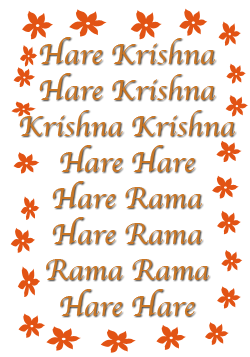
Lord Brahma replied, “The sixteen words – Hare Krishna, Hare Krishna, Krishna Krishna, Hare Hare; Hare Rama, Hare Rama, Rama Rama, Hare Hare – are especially meant for completely destroying all the contamination of Kali. To save oneself from the contamination of Kali-yuga, there is no alternative in all the Vedas except the chanting of this sixteen-word mantra. [5-6]

(Note: Some versions of Kali Santarana Upanishad have Hare Rama appearing first, followed by Hare Krishna. This is possibly a change by followers of Rama who placed Rama’s name before Lord Krishna’s. We draw this conclusion because other scriptures such as Agni Purana, Sanat-kumara Samhita and Vayu Purana, which refer to the maha-mantra, all have the maha-mantra begining with Hare Krishna. – Sri P)

“This maha-mantra consisting of sixteen names of Krishna is the destroyer of the (16-layered) illusory covering of all the living entities. Only when the coverings are destroyed, Lord Krishna, the Supreme Personality of Godhead will appear in the heart of the living entities, just like the sun appears with full intensity when the clouds are removed.” [7]

Shrila Narada again inquired from Lord Brahma – “What are the procedures and rules for chanting this maha-mantra?” [8]

Lord Brahma replied, “There are no rules and regulations to chant this maha-mantra. It should be chanted always irrespective of whether one is in a pure or impure condition.” [9]

When one chants the 16 names of the maha-mantra 35 million times (sardha trikotir), he absolves himself of the sins of killing a brahmana or a kshatriya, stealing of gold or engaging in harmful activities towards one’s forefathers or other living entities. [10]

By chanting the maha-mantra, one becomes quickly purified from all sins accumulated due to rejecting all of one’s duties in our past lives. Thus the Hare Krishna maha-mantra, is the only means, the only means, the only means of thoroughly and immediately purifying oneself in Kali-yuga. Thus ends the Kali-santarana Upanishad. [11]

Categories
Latest News

Sri Prahlada kirtan at Qi Yoga March 5th

Categories
Latest News

What are the Benefits of Kirtan?

Note from Sri Prahlada

January has been a wonderful month for kirtan in Sydney. On the 22nd and 23rd, we had a 40 hour kirtan celebrating the 40th Anniversary of the Hare Krishna community in Sydney and Australia. One of the highlights was a performance by Swamis from Satyananda Yoga at Mangrove Mountain. Another highlight was the kirtans performed by Gaura Vani and his USA based group As Kindred Spirits. They are currently on tour in Australia and I had the fortune of attending each of the group’s six concerts in Sydney. I have a particular affection for these kirtan musicians as lead singer Gaura Vani and bass player Shree Shyam and I all went to school together in 1980s at an ashram in Vrindavan India.
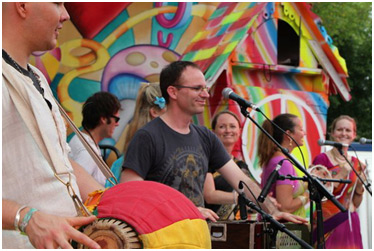
In January we also had the opportunity to share kirtan on the Lily World stage for each of the two days of the ‘Big Day Out’ in Sydney. It was a different environment to that of a peaceful Yoga School, so we kept the tempo more upbeat. Despite the 40+ degree heat, hundreds of people danced in front of the stage. After the second day, I asked two girls who had been dancing ecstatically in front of the stage how they liked the kirtan. They replied they had never experienced anything so wonderful and blissful as kirtan. They said that although it was over 40 degrees, they had goose bumps all over the bodies from the chanting!

So, just what happens to people in kirtan? This is the focus of this issue of Kirtan Magic, covered in our feature article entitled “What are the Benefits of Kirtan?”. Please enjoy and feel free to get involved by commenting below, and of course I hope to meet you soon at one of our upcoming kirtan events!

With affection,
Om & Prem
Sri Prahlada


[headline h=”1″]What are the Benefits of Kirtan?[/headline]
Recently, I was asked to explain the benefits of kirtan to the owner of a yoga school who was considering organizing a kirtan concert. My response was that in kirtan people experience:

• Inner peace
• Happiness
• Opening of the heart with feelings of love and compassion
• Connection with the Divine and other kirtan participants
• On occasion, goose bumps and tears as the heart jumps with joy

I then offered that there were three authorities from which to understand the benefits of kirtan:

1. Personal experience
2. Academic research findings
3. The authority of Vedic-yoga texts.

[headline h=”1″]Personal experience[/headline]
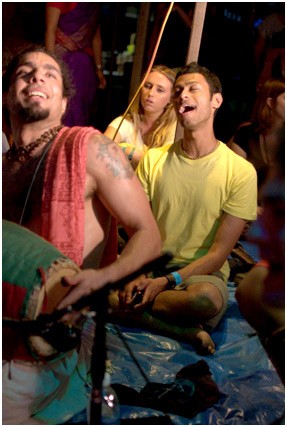
Most kirtan authorities share that the benefits of kirtan cannot be explained in words, it has to be experienced in order to be understood. How do you explain the taste of a mango to someone who has never tasted these fruits? You can intellectualise over the taste by saying its something like a cross between a peach, pineapple, and an orange, but until a person tastes a mango, they can never really know it’s flavour. The same is with the experience of kirtan – you have to experience it to know what it is. Sacinandana Swami put it eloquently when he wrote: “Words can show us the direction in which to look for the kirtan-experience, but only when you sit down, move towards your inner space, and then sing out, will you start to know what kirtan really is. Because at that time your soul will rise up and start to dance…”

Another thing is that different people will experience kirtan differently. Some people might immediately love it, like meeting a long lost friend or returning home after a long time away. Others might take a little while to get used to an unfamiliar experience. Additionally, kirtan can often sound raw and unpolished. Hence, some might find the mango a little green – immature and therefore unpalatable. But in India, people love green mangos (eaten with salt and chilli powder pickled) as much as they love ripe mangos. They can also discern between different varieties of mangos – some are sweeter and others have a slightly bitter taste, others stringy, and others are more or less firm. Similarly, a kirtan connoisseur can discern and appreciate different varieties and flavours of kirtan.

My personal experience of kirtan is that when the lead chanter and the group participants are sincere and sing from the heart with devotion – there is nothing in the world that has the power to move and uplift me like kirtan. When I look back on my life, my happiest, most blissful moments, were all in kirtan.

[headline h=”1″]Academic research findings[/headline]

In the past several years, with the increasing awareness and appreciation of kirtan in the Western yoga community, it has also come to attract the attention of academic researchers. In the USA, Black and Vaugn made kirtan the focus of their Masters theses (respectively in music and psychology), while Cooke made it the focus of her PhD in music. Each of these qualitative studies involved interviews with kirtan participants. Interestingly, three similar themes emerged relating to the benefits of kirtan. In each study it was found that kirtan:

1. Induces a powerful sense of connection with the Divine.
2. Induces trance like meditative states of altered consciousness, including feeling of spiritual upliftment that last long after the kirtan event has concluded.
3. Opens the heart, allowing greater connection and community amongst other kirtan participants, even those of diverse backgrounds and traditions.

[headline h=”1″]The teachings of the Vedic-yoga texts[/headline]
Interestingly, study of the Vedic-yoga texts reveals similar themes, but describes the benefits of kirtan at a deeper level. This is a level that is not consciously perceptible to the senses. My analysis of the Vedic-yoga texts unveils five themes:

1. The first benefit is that kirtan chanting destroys negativity. The Yoga Sutras (1.27-31) state that chanting om destroys “disease, procrastination, laziness, doubt, pain, nervousness, and lamentation”. According to the Vedic-yoga tradition, such negative conditions as disease, and mental distress are the result of deeper negative psychological impressions from unwholesome actions performed even in previous lifetimes – bad karma. Therefore, the more important benefit of kirtan is that it destroys the seeds of negativity waiting to sprout as the result of negative karma from previous lifetimes. In this regard, the Brhad-vishnu Purana goes as far as saying that chanting one holy name destroys more negative karma than a person is able to commit. It is natural that when a person is free from the burden of negativity they will be peaceful and happy. This leads us to…

2. The second benefit is that it awakens blissfulness or natural joy within the heart. Arjuna declares in the Bhakgavad-gita (11.36), “the world becomes joyful upon hearing your name”.

3. The third benefit of kirtan is that it is easy to perform. The Skanda Purana states that chanting the name of Hari (a name of the Divine which means one who takes away all distress) just once, guarantees liberation. Because it is easy, it is also described as the most practical method for attaining spiritual perfection, particularly in this age, hence…

4. The fourth benefit is that it is described as the topmost spiritual process. The Srimad Bhagavatam describes kirtan as the “ultimate spiritual practice” (6.3.22) and as the “doubtless and fearless way of success” (2.1.11) in any endeavour – spiritual or material. Similarly, Bhagavad-gita (10.25) describes it as the topmost form of sacrifice.

5. Finally, the fifth benefit of kirtan is that it creates Divine connection, which is the greatest of all benefits. This connection transpires both as the experience of Divine presence and as the awakening loving affection. Regarding the experience of Divine presence, Krishna tells Narada in the Padma Purana; “My dear Narada, actually I do not reside in my abode, Vaikuntha, nor do I reside in the heart of the yogis, but I reside in that place where devotees sing my holy names”.

The loving affection that awakens in the heart during kirtan is mutual both for the chanter and the Divine. The chanter comes to love the Divine, as Arjuna tells Krishna in in the Bhagavad-gita (10.25) that when people hear Your name “everyone becomes attached to you”. Likewise, the Divine comes to loves the chanter ever more. In this regard Krishna declares in the Adi Purana, “When a person chants My name, whether out of devotion or indifference, then the chanters name will remain forever in My heart. I will never forget such a soul”.

So you can see, the benefits of kirtan described in the Vedic-yoga texts is similar to those people explain from their personal experience, but it goes further by describing benefits at a level that is beyond the purview of our limited sensory perception.

For example, while people describe that kirtan relieves distress and induces a state of peace. The Vedic-yoga texts reveal, however, that the effects of kirtan destroy negative karma even from previous lives that is yet un-manifest.

Similarly, while people describe a felt sense of spiritual connection. The yoga texts reveal that this connection is mutual and reciprocated by the Divine, who “will never forget” the name of the person who chants the holy name.

[headline h=”1″]The teachings of Chaitanya[/headline]
Chaitanya is the personality who 500 years ago, revolutionised spirituality in India by promoting kirtan as the easiest and most practical path to enlightenment. He wrote eight stanzas of spiritual instruction called the Shikshastakam. The first of these stanzas summarises the teachings of the Vedic-yoga texts by describing seven benefits to chanting similar those described above. These are that kirtan:

1. Cleanses the heart of all sinful impressions and desires
2. Destroys all suffering by ending the cycle of birth and death
3. Awakens all auspiciousness and good fortune
4. Reveals knowledge of ones true spiritual nature and relationship with the Divine
5. Awakens the highest bliss
6. Delivers the nectar of immortality
7. Allows one to share the highest Divine love by purifying one of all selfish desires for personal pleasure.

[headline h=”1″]Conclusion[/headline]
In conclusion, analysis of people’s personal experience as well as the Vedic-yoga teachings reveals that kirtan offers wonderful material, emotional, and spiritual benefits – for body, mind, and spirit. Sometimes kirtan is compared to India’s legendary kalpa-vrksa “wish-tree”, which can grant wishes. So why limit our comparison of kirtan to a mango which must be experienced to know its flavour? A wish-tree can deliver pineapples, coconuts, and anything else you might desire.

What benefits have you gained from kirtan? What are your most memorable kirtan moments? Please visit our blog to share your experiences!
[headline h=”1″]Want To Use This Article?[/headline]
You’re welcome to share this article as long as you include this complete blurb with it:
For more kirtan articles, music samples & downloads, event news, and short films and other kirtan resources visit http://www.sriprahlada.com and become a member of Sri Prahlada’s Kirtan Community for FREE. Aside from instant access to a lot of fantastic kirtan resources, you will also receive Sri Prahlada’s e-newsletters with news, realizations, and experiences with kirtan.
Categories
Latest News

Different Forms of Kirtan

The power of kirtan is not only being increasingly recognised and embraced in the yoga community, but practitioners of other religious traditions are embracing it as well; creating new kirtan forms. What are some of these forms of kirtan and how is a kirtan practitioner to respond to them?

Within the Jewish tradition, we have the Kirtan Rabbi. He sings Hebrew Kirtan, which involves a weaving of traditional Jewish liturgy and musical modes with the call-and-response kirtan format as well as kirtan instrumentation. Kirtan Rabbai’s Hebrew kirtan uses the traditional call-and-response form – but utilises traditional Jewish modes of notation drawn from both European and Eastern sources.

Then there is Christian Kirtan, which is engaged in some churches to celebrate the service of Holy Communion. One way this practice differs from Hebrew kirtan is that it involves not only using the call-and-response format and instrumentation of kirtan, but also singing in Sanskrit. This is, Sanskrit versions of Christian prayers or Christian versions of Sanskrit prayers such as Jaya Jesus Christ, Jesus Christ (glory to Jesus Christ, Jesus Christ).

Within the Hindu and Yoga traditions, we find kirtans dedicated to numerous deities such as Kali, Hanuman, Ram, Krishna, and Shiva. Study of the Vedic literatures reveals, however, that kirtan is exclusively a limb of bhakti that stresses devotion to Krishna. In the Gita Krishna stresses the importance of kirtan by characterising his devotees as those who always do kirtanasatatam kirtayanto mam” (Bhagavad-gita 9:14). Such statements have led to the development of kirtantheology and practice. In the statements of other Hindu deities such as Shiva, Durga, and Kali in Vedic literatures, such mention of kirtan as a means of worship is largely conspicuous by its absence. Nonetheless, although the scriptures endorse Krishna kirtan, the practice is so blissful and satisfying that other spiritual paths have adopted it to chant the names of Siva, Durga, Kali, and other deities. And now Jewish and Christian kirtan have emerged as well.

Personally, rather than composing my own chants, I prefer to sing mantras in glorification of Krishna as found in the scriptures, or, as written by great saints. Nonetheless, I acknowledge that whether in Sanskrit, or Hebrew, or any other language, the most important principle in kirtan is that Divine names are being glorified. The great spiritual teacher Srila Prabhupada stated, “Actually, it doesn’t matter – Krsna or Christ – the name is the same. The main point is to follow the injunctions of the Vedic scriptures that recommend chanting the name of God in this age” (Science of Self Realization, Chapter 4). And it is not only the Vedic tradition that recommends the chanting of the holy names of the Divine with musical instruments. In the Old Testament we find: “Praise him with timbrel and dancing, praise him with the strings and pipe, praise him with the clash of cymbals, praise him with resounding cymbals” (Psalms 150:4-5). Why not fulfil this injunction to praise the lord, through kirtan!

Categories
Latest News

New Year’s Eve Ecstasy Event: Friday 31 December 2010 17:00

Celebrate the coming of the New Year by setting the right intention and example: a wholesome (radical for New Year’s Eve!) evening starting with a transformational Yoga class and meditation with Fabio Fabbri, delicious, healthy vegetarian buffet food, followed by a blissful Kirtan (live music with Yoga chants and dancing) with Sri Prahlada & The Bhakti Band.

Bring along your friends, entire family including of course, your children. The littler ones also get to set their New Year intentions with Art and Craft activities with a Steiner playgroup leader for the duration of the Yoga class. And all that – away from crowds, on the park, just opposite the beach, at Avalon. Sound the perfect way to end the year?

17:00 Yoga class and children’s art and craft

18:30 Dinner – vegetarian buffet

19:30 Kirtan – music, chanting and dancing with Sri Prahlada & the Bhakti Band

Avalon Recreation Centre, 59 Old Barrenjoey Road, Avalon.

Bookings essential!

Contact Natalia here >

Download flyer here!

Categories
Latest News

Kirtan lifestyle: The most valuable thing

Those who are actually advanced in knowledge… worship Kali-yuga because in this fallen age all perfection of life can easily be achieved by the performance of kirtana.

Srimad Bhagavatam 11.5.36

Kirtan is not just spiritual meditation music; it is a philosophy and way of life. To me it represents the essence of what I learned from my dad in a critical period of his spiritual journey in the late 1970s and the most impressionable period of my growth from ages 4-5, which by divine arrangement came to coincide. He shared the principles of the kirtan lifestyle over the span of a year, not as a set curriculum, but through the course of introducing me to various powerful spiritual experiences. These included, preparing vegetarian food, offering it to the divine, and eating it as sacred prasadam or “mercy”.  And an introduction to the ancient yoga-texts such as Bhagavad-gita and Srimad Bhagavatam, with all of their profound wisdom. He also taught me about Japa which like kirtan involves mantra repetition, but unlike kirtan which is practiced congregationally, japa is practiced as private meditation. Amongst these teachings, I found gathering with others for call-and-response kirtan chanting sessions, the most exciting. My dad said that this was the most important spiritual practice for our time. But really, they all go together as parts of a complete bhakti-yoga program.

In my experience, the kirtan lifestyle is the most profound teaching there is. This is a big claim, especially considering that I have traveled all over the world shared with people of many diverse cultures. Further, I have earned several university degrees in communication and psychology, contributed to peer reviewed academic journals, taught university lectures and self-development workshops, and am currently completing a PhD. When I started university I believed that the science of human behaviour or psychology would give me stronger more satisfying answers to the human conditions of suffering and happiness, dissatisfaction and fulfillment, failure and success. After years of study, lecturing, and writing, however, my realisation is that these understandings are weak in comparison to the spiritual principles relating to kirtan that I learned from my dad. What he taught me over the span of a year, I have been realising ever since, gaining deeper realisation and appreciation with each passing year.

Do you agree that kirtan is a lifestyle as opposed to simply sacred music? What do you think of my claim that it is the most valuable thing I know? Feel free to offer any thoughts or questions on this topic.

Categories
Latest News

A history of the sacred practice of kirtan – Part 2

I taught this eternal practice of yoga to Vivisvan the sun-god; Vivisvan gave it to Manu, father of mankind; Manu passed it to King Iksvaku. Thus handed from one to another, it was known by saintly kings. But over a great passage of time this yoga was lost to the world. Now I am teaching the transcendental secret of this ancient yoga to you, Arjuna, because you are my devotee and my friend.

Bhagavad-gita 4, 1-3

Lost in materialism

I waited all day for bedtime, when my dad would continue his spiritual history of kirtan and the world. That history spoke of an ancient spiritual civilization wherein yogis lived in harmony with one another and divine nature, and spent most of their time absorbed in blissful spiritual practices such as kirtan, a form of meditation based upon sacred sound. With the advance of time, however, the influence of materialism slowly became stronger and many yogis came to identify more with the external material-powers of technology than with internal spiritual practices.

My dad explained that with declining spiritual vision, the former yogis became increasingly greedy, lusty, and angry. And, just as an elderly person becomes increasingly week and dependent upon the support of a walking cane, these people became more dependent on external things as a source of happiness. Eventually, spiritual practice was forgotten in the greater community consciousness just as an adolescent forgets the innocence of childhood. Even their access to spirituality was externalised and materialised, taking to be designated by birth rather than by inner qualities. As such, “spirituality” came to uphold a brutally oppressive cast system. All of this led to a scarcity mentality of competition and conflict where people and Mother Nature came to be seen as things to be used and exploited rather than as divine personalities to be respected, nurtured, and protected.

As humans took from Mother Nature according to their greed rather than according to their need, she withdrew her bounties deep within her surface as a turtle protects itself by withdrawing its limbs within its shell. Thereupon humans were forced to work hard by ploughing, digging, and drilling to reach nature’s resources. When the harmony that had existed for so long between humans, nature, and the Divine was lost, even learned people came to view the forgotten mysteries of spiritual practices like kirtan as the stuff of superstitions, myths, and legends. Meanwhile the external squirrel like accumulation of things substituted the sage like inner cultivation of peace, love and joy, as indicators of success. In time the people who had become like squirrels realised that no matter how many acorns they collected, they were not happy. Alcohol and drugs were invented to address this issue, making them even less self-aware and ever more dependent on external stimulants as sources of joy. A new profession called psychology was also invented, supplying people theories and drugs to motivate them to get back out play harder in the squirrel-race to accumulate the externals of money, sex, drugs, and fame.

Spiritual revival

Through all of this history, small bands of yogis had continued to practice, preserve, and teach the forgotten yoga tradition of internal spiritual practice. And, as people became disillusioned and questioned the external materialistic paradigm, these yogis were there to revive the humans who had become like squirrels, by providing access to spiritual power and thus reminding them about their earlier greatness. This they were able to do thanks to Vyasa, the yogi who thousands of years earlier had the foresight to codify the teachings of yoga within texts called the Veda or The Knowledge, also called yoga texts.

Some 500 years ago, Sri Caitanya, a saint, spiritual reformer, and Divine incarnation, gave particular emphasis to kirtan. Braking major social trends he made Divine connection available to everyone without distinctions of caste, colour, or creed, giving everyone the opportunity to become fully enlightened through this simple and blissful spiritual activity. In the 1960’s Bhaktivedanta Swami Prabhupada introduced kirtan to the West, leading a group of singers and dancers under a tree in New York’s Tompkins Square Park through the summer of 1965. Later he sent disciples to Europe where they enlisted the support of Beatles John Lennon and George Harrison, who were responsible for having Hare Krishna kirtan released as a single that topped music charts around the world. As my dad ended the story, he showed me a kirtan album he had recently purchased called “The Radha Krishna Temple”, produced and released by George Harrison on the Apple label.

When dad left, closing my bedroom door, I lay in bed wondering if I might ever see the yoga texts he spoke of, or meet the modern yogis who live by them. I too wanted to be a yogi… One day, several months later, I felt this dream was becoming fulfilled when my dad gave me the Sanskrit name Prahlada. He said he was naming me after a five year old yogi from thousands of years before. Prahlada means “one who gives happiness”. My father gave me a lot of hope and happiness that day when he named me Sri Prahlada. Through my life, I have endeavoured to share that happiness with others, particularly by sharing the magic of kirtan.

Have you ever wondered what it might be like to live as a yogi and study the ancient yoga texts? Feel free to comment with any thoughts or questions.

Categories
Latest News

A history of the sacred practice of kirtan – Part 1

In the beginning of creation, the Lord of all creatures sent forth generations of people and devas [demigods], along with sacrifices, and blessed them by saying, “Be thou happy by this yajna [sacrifice] because its performance will bestow upon you all desirable things. The devas, being pleased by sacrifices, will also please you; thus nourishing one another, there will reign general prosperity for all”.

Bhagavad-gita 3, 10-11

My introduction to kirtan

When I was five my dad got into kirtan, an ancient form of meditation based upon sacred music. My dad was a child of the 1960s, which were a critical time in modern history when people, particularly the disillusioned youth, began questioning the status quo. Many also began to recognise that India’s ancient yogi might hold the answers to the hollowness and superficiality that seemed to characterise most people’s lives in modern society. My dad was one such questioning youth who became intrigued by the yogis and the practice of kirtan. When I was born dad was on this spiritual journey and as I grew, he endeavoured to imbibe within me all that he learnt. One night before bed my dad told me the following account of the Earth’s spiritual history, as described in India’s yoga texts:

Once upon a time…

In the far off exotic land today known as India, our ancestors lived as yogis in sustainable rural communities called ashramas. These yogis were also called rishis, which means “seer”, because they cultivated their “third eye”. This is the minds eye of inner spiritual consciousness, which shone in them like an internal blazing mid-summer sun. They cultivated their inner eye through meditation practices such as kirtan, and by proper understanding of the associations between the causes and consequences of all things, allowing them to “see” past, present, and future. Although they lived simply, the life of the yogis was rich with the jewels of satisfaction, peace, spiritually, and a universal harmony between humans, animals, the rest of nature. All parties in this relationship flourished like a perennial spring with abundant beauty, fragrance, vitality, and growth. The yogis didn’t have to work particularly hard because Mother Earth provided them her rich bounty of sweet juicy fruits, nutritious grains, and succulent vegetables without the need for ploughing and sowing fields with seeds for food. As the yogis were vegetarian so there was also no need to hunt and slaughter innocent animals. Additionally, Mother Earth generously sent forth her valuable minerals including jewels and gold to the surface of the earth, these the yogis used for making medicine, ornaments, and for worship; expressing appreciation to the Divine. Mother Earth’s seasons were as predicable as a Swiss watch, such that yogis didn’t need watches, they could accurately tell the time and the date from the weather. In this harmony, the clouds only sent rain at night when the yogis slept, enough to properly irrigate nature’s vegetation, so the sun could shine pleasantly all day long. Without the need for hard work, the yogis devoted their time to nurturing beautiful relationships called yoga or links between each other, with Nature whom the addressed as Mother Nature, and with the Supreme Divine whom, amongst many other Holy Names, was called The Universal Father. They did this through the inner cultivation of spiritual practices that were given by the Supreme Divine at the beginning of time, and handed down from one yogi teacher to the next, in an unbroken chain of disciplic succession.

There my dad smiled and left off, telling me the story would be continued the next evening…

As I lay in bed falling asleep, I wondered what happened to this beautiful spiritual civilization.  I also wondered if it might be possible to experience the peace, love, joy, and harmony that the yogis shared, even today.

What do you think? Feel free to comment with any thoughts or questions you might have.

Categories
Latest News YouTube Videos

Sharing a lifetime of Kirtan

Artists:
Lead vocal and harmonium: Sri Prahlada
Bass: Shankara (Ashley Turner)
Acoustic guitar: Svetadvipa
Mrdanga: Vamsidhari
Backing vocals and karatala cymbals: Erin
Engineer – Wes Johnson
Assistant Engineer – Giancarlo Pesce
Filming, editing, production: Vraja Dham

Special thanks to Mukta of Manly Yoga, Vara of ISKCON Sydney, and Maadreya, for facilitating the making of this film in many different ways.

Filmed live at Manly Community Centre 6 November 2010

[hr]

This video is so excellent. I hope everyone in the world hears these kirtan realizations. Absolutely beautiful!

Ekendra Dasa, Australia

The kirtan night that was recorded will forever be embedded in my heart. That was something special. Life is Kirtan, Kirtan is life. Thanks Sri Prahlad.

Svetadvipa Dasa, Australia

[hr]